How to Spot a Fake Pokémon Card
Eight simple checks - from the light that passes through the card to how it feels in your hand - before you close a deal on a card you're not sure about.
Updated 23 July 2026
A fake Pokémon card almost always looks fine in a listing photo - the problem only shows up once it's in your hand. The next five minutes save you a bad deal: eight simple checks, no special equipment, that fit into any in-person meetup before you hand over payment.
Real vs. fake: quick comparison table
No single check is enough on its own, but a combination of a few small signals almost always gives it away. This table rounds up the eight checks in this guide - genuine vs. fake - so you can scan it quickly before digging into the details of each one.
| Check | Genuine card | Fake card |
|---|---|---|
| Light test | Blocks almost all light - at most a faint dotted pattern | Light passes through almost evenly, sometimes you can see separated layers |
| Print and font | Sharp font, consistent weight, precisely aligned | Blurry edges, font subtly off, colors run too saturated |
| Texture and holo | Solid finish; holo has a real etched pattern that shifts direction | Feels thin/glossy/plasticky; holo is a flat rainbow-gradient sticker |
| Card back | Same fixed blue and design across every set and era | Blue too dark, too light, or greenish; outline too thick or thin |
| Weight | Specific weight and feel from its layers (stock, black core, coating) | Too light and flexible, like reinforced photo paper |
| Snap | A gentle flex produces a distinctive "snap" | Doesn't produce that snap, or sounds completely different |
| Catalog | Number, rarity, and attacks match the official catalog exactly | Doesn't match any real card in the set, or the set doesn't exist |
| Price | Close to the live price anchor, within the 5% threshold | Huge gap below market, usually paired with pressure to close fast |
The light test: what happens when you hold the card up to a window
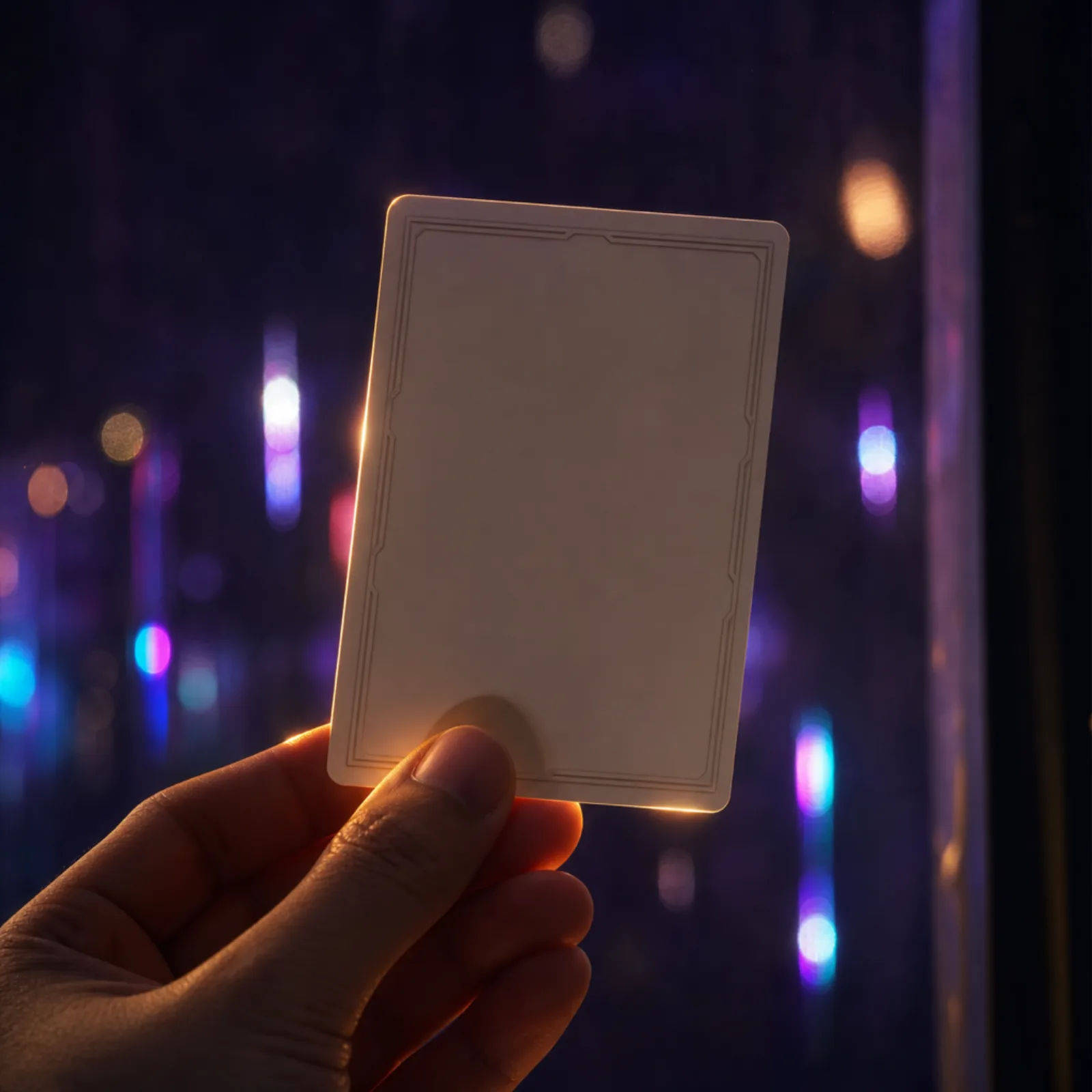
Since 2002, official Pokémon cards have been printed with a black layer in the middle of the card stock (a "black core"). Hold the card up to a window or a phone flashlight: a genuine card blocks almost all the light - at most you'll see a faint dotted pattern, not a full image. A fake, printed on plain cardstock without that black core, lets light through almost evenly across the whole card, and sometimes you can actually see the printed layers separated like a sandwich.
Print quality and font
Zoom in on the HP number, the card's name, and the Pokémon logo. On a genuine card, the font is sharp, consistent in weight, and precisely aligned. On a fake, you'll typically see blurry edges, a font that's subtly off from the original (too rounded or too thin), misaligned letters, and colors that run more saturated than the real thing. A spelling mistake in an energy type or attack text - a missing letter, a flipped character - is almost always a dead giveaway.
Card texture and holo pattern
Official card stock texture shifts a bit by era, but it always has a solid finish - not glossy like photo paper, not soft like office paper. A fake typically feels too thin, too glossy, or plasticky, like it was printed on a sticker.
For holo cards, the key check is the etched pattern under the foil: a genuine card has a real diffraction pattern (cosmos holo on older sets, a W-pattern on newer ones) that shifts direction and shimmers differently at different angles. A fake usually just has a flat rainbow-gradient sticker with no real etching under it - it looks "flat" even when you tilt the card.
Back color, weight, and snap
Back color
The back of every official Pokémon card - every set, every era - is the same fixed blue and the same design. Lay the card you're unsure about next to one you know is genuine: if the blue is too dark, too light, leans greenish, or the Poké Ball outline on the back is thicker or thinner than usual, that's a clear tell.
Weight and snap
Checking the official catalog
Every official card has an exact catalog number within its set (e.g. 006/165 in 151) and a matching set symbol. Check the card against pokemontcg.io or another official catalog: if the number, rarity, or attacks don't match any real card in that set - or the set itself doesn't exist - it isn't a "rare pull you'd never heard of," it's an entirely made-up card. This check catches fake "ultra-rares" instantly - cards that don't exist in any real print run.
Priced too low? That's not luck, it's a red flag
Suspect a fake on a listing? Here's what to do
- Ask for more photos: the card against light, the full back, a close-up of the holo at an angle.
- Don't send payment before an in-person meetup or a full inspection - see our safe-trading guide for meeting up and paying securely.
- If a listing looks off - price far from the anchor, refusal to send more photos, pressure to close fast - report it or the seller through the report button on the listing page. Reports go into the moderation team's queue.
- Never buy sight-unseen at a "too good" price, especially when it comes with pressure to close quickly.
How haklaf lowers the risk
Live price anchor + fairness badge - every listing on the board syncs against the market price, so a listing with an unreasonable price stands out immediately instead of getting lost among dozens of Facebook posts.
Report and block - every listing and every profile can be reported; reports go into the moderation team's queue, and repeat offenders get blocked.
No payment through the site - haklaf never moves money or ships packages for you. You always meet up, inspect, and pay directly - which means you always get the chance to run every check in this guide before any money changes hands. Next step: documenting a card's exact physical condition is covered in our card condition scale.
Frequently asked questions
Can a fake card get a grade from PSA or CGC?
No. Grading companies check authenticity before they even assign a grade, and a fake card gets rejected at that stage - it doesn't come back in a slab. What does happen: fake slabs - plastic cases that mimic PSA/CGC with a fake card inside. If you're buying a "graded" card, always check the certification number on the official site (psacard.com or cgccards.com) and confirm it matches the card in the photos.
What's the difference between a fake card and a proxy?
A proxy is a copy a seller openly labels as such - for playing at home, not for sale as an original. That's not counterfeiting as long as there's no deception. The moment someone sells a proxy as if it were an official card, that's the exact definition of a fake, regardless of print quality.
I accidentally bought a fake card - what now?
If it was a haklaf deal, report the seller through the report button on the listing or their profile - it goes into the moderation team's queue. If it happened off-platform (Facebook, WhatsApp), there's no way to reverse a cash or Bit payment that already went out - which is exactly why every check in this guide is meant to happen before money moves, not after.
How long do all these checks take?
Under two minutes, face to face: hold the card up to light, look closely at the print and holo, check the back, and give it a light flex to test the snap. If a seller rushes you or refuses those two minutes, that's the clearest red flag there is.
The seller refuses to meet or let you inspect the card - what does that mean?
Usually that there's something to hide. A legitimate deal survives a two-minute inspection without issue. More on chat red flags and closing a deal safely is in our safe-trading guide.
Which check is the most reliable?
No single check is absolute proof, but the light test (the black core) is the most reliable on its own - it's nearly impossible to fake without a full production run, it takes one second, and needs no equipment. The strongest combo is light test + official catalog check: a card that passes both is almost always genuine. Keep in mind this specific test is tuned for Pokémon cards - One Piece cards use different authentication features.
A card that passes every check above and looks genuine - the next step, if its physical condition justifies it, is to consider grading. Full details on cost, turnaround, and shipping routes are in our grading from Israel guide.